Resistance
Resistance VG-4pkBootyBands Resistance Bands
$21.998,000+ bought last month
View on Amazon
Resistance bands come in four practical formats for home gym use. Mini loop bands, often called booty bands, are short closed circles worn around ankles or just above the knees. They are used for hip abduction, glute activation, and leg work. Full-length flat bands are open-ended and longer, suited for stretching, shoulder mobility, and assisted pull-up progressions. Tube bands with handles behave more like cable machines and are built for rows, curls, and pressing movements. Figure-8 bands are shaped for ankle and wrist isolation exercises.
For most home gym owners, a mini loop set or a flat loop set covers the widest range of exercises with the least cost and storage space. If you plan to use bands primarily for glute and hip work, a mini loop booty band set is the correct category. If you want shoulder and upper-body pulling work, a longer flat or tube band is the better fit. Buying both is not necessary at the start.
Resistance bands are commonly color-coded to indicate tension, but the pound ratings assigned to each color are not standardized across the industry. A purple band from one brand may feel completely different from a purple band from another. For the resistance band products in this guide, exact resistance values in pounds per color are not published in the product listing data. Verify the resistance range for each color on the product page before purchasing.
As a practical starting point, most home gym users benefit from a set with at least three distinct tension levels. Use the lightest band for warm-up activation and upper-body isolation work. Use a medium-tension band for core movements and accessory exercises. Reserve the heaviest band in your set for hip drives, leg abduction, and assisted pull-up work where you need real load to feel a training effect. The CFX MZCFX set is available in Green, Purple, and Pink, giving you three color-differentiated options in a single purchase at $9.99.
Loop bands form a closed circle and stay in place around a limb or post without tying. This makes them faster to set up and safer to anchor than an open-ended band tied in a knot. The Resistance VG-4pkBootyBands is a closed-loop set with a 4.8-star rating across 21,700 reviews and 8,000 buyers per month, making it among the most consistently purchased band products on Amazon.
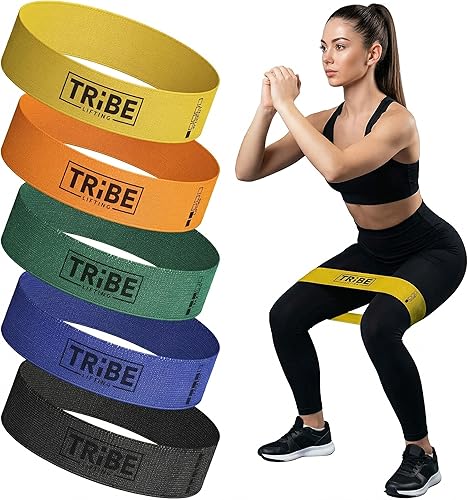
Open-ended flat bands require anchoring at both ends or tying, which adds a step but gives you more flexibility in length adjustments. For home gym users who want a compact, no-setup option that can be grabbed mid-session without interrupting a workout flow, closed loop bands are the more practical choice. The Tribe 5 Pack Leg Resistance Bands is another closed-loop set. At 7.36 ounces for the full five-band set, it fits in a gym bag side pocket, making it viable for travel or outdoor training days as well.
Published specs for resistance bands are often sparse, which makes buyer demand signals more useful than usual when comparing options. A product with tens of thousands of reviews and consistent monthly buyers indicates real-world durability across many users and training styles.
The Resistance VG-4pkBootyBands carries 21,700 reviews and 8,000 buyers per month at a 4.8-star average. The CFX MZCFX shows 21,225 reviews at 4.7 stars. The Tribe 5 Pack Leg Resistance Bands has 4,900 reviews at 4.7 stars with 10,000 buyers per month. All three cleared the site's quality floor of at least 3.8 stars and a minimum of 100 reviews or 100 monthly buyers. When a band set maintains a 4.7 or higher rating across more than 4,000 reviews, it signals that the product holds up through real training sessions, not just first impressions. Gymso is an Amazon Associate and earns from qualifying purchases; this funds our research and does not influence rankings.
Bands work best as a complement to free weights and bodyweight movements, not a full replacement for heavy loading. Their defining characteristic is accommodating resistance: tension increases as the band stretches further, so load peaks at the top of the movement rather than staying constant like a dumbbell. This changes the strength curve in a useful way for exercises like squats, hip thrusts, pull-aparts, and face pulls.
For practical programming, use a light band above the knees during bodyweight squat warm-ups to activate the glutes before loading a barbell. Use a medium band for banded push-up variations or pull-apart shoulder exercises between heavier sets. A heavier band looped over a pull-up bar can offset some of your body weight, allowing beginners to complete full-range pull-up reps they could not otherwise do. Bands require no floor space when in use for standing movements and roll up for storage in seconds, which makes them compatible with any home gym size.
Resistance bands are among the most affordable pieces of equipment you can add to a home gym, and the price range for quality sets is narrow. The CFX MZCFX is available at $9.99 for a three-color set, making it the lowest-cost entry point among the options in this guide. The Tribe 5 Pack Leg Resistance Bands comes in at $19.97 for five bands. The Resistance VG-4pkBootyBands is $21.99 for a four-band set.
All three sets fall between $10 and $22 and carry verified ratings of 4.7 or higher across thousands of reviews. In this category, spending more does not reliably mean getting a better product for most home gym users. The decision between sets comes down to the number of bands in the pack, the length and loop format, and the specific tension levels offered, not price alone. Check the product page for current resistance values per color before ordering.
Resistance bands are durable but not indestructible. Inspect every band before each session. Look for cracks along the surface, thinning sections, discoloration, or areas where the band has started to fray or peel. A band showing any of those signs should be retired before use. A snap under load can cause a significant snapback injury, particularly to the face or hands.
Store bands away from direct sunlight and heat sources. UV exposure and heat degrade elasticity over time, shortening the usable life of the band even if it appears intact on the outside. Rolling bands into a loose coil and keeping them in a bag or drawer is sufficient for most home gym settings. Do not hang bands over sharp hooks or edges that can create stress points in the material. The listing data for the products in this guide does not publish a rated lifespan; replace bands based on visual inspection rather than a fixed schedule.
Booty bands are short mini loops worn around the knees or ankles for hip, glute, and leg activation work. Full-length flat resistance bands are longer and open-ended, better suited for shoulder mobility, stretching, and assisted pull-up progressions. The two formats are not interchangeable for most exercises.
Three tension levels cover most home gym needs: a light band for upper-body and mobility work, a medium band for core and accessory exercises, and a heavier band for glute and hip training. Sets like the CFX MZCFX at $9.99 include three color-differentiated options in a single purchase, which is a practical starting point.
Yes. The product listings in this guide do not publish a rated lifespan, so replace bands based on visual inspection rather than a time schedule. Signs that a band needs replacement include surface cracks, visible thinning, discoloration, and loss of snap-back tension. Inspect before every session.
Resistance bands complement free weights well. Use light bands for glute activation before barbell squats, for face pulls between pressing sets, and for assisted pull-up progressions. They add accommodating resistance, which means load increases as the band stretches, a different stimulus than a fixed dumbbell weight.
No. Color-coding for resistance bands is not standardized across the industry. A green band from one brand may have a completely different tension rating than a green band from another. For all three band sets in this guide, exact pound ratings per color are not published in the listing data. Check the individual product page to confirm resistance values before ordering.
Squat rack uprights, power cage posts, and sturdy support columns are the safest anchor points. Door anchor accessories designed for this purpose are also a common option. Avoid anchoring to sharp edges, exposed screws, or rough surfaces that can cut into the band material under tension. For most loop band exercises, no anchor is needed since the band wraps around both limbs.